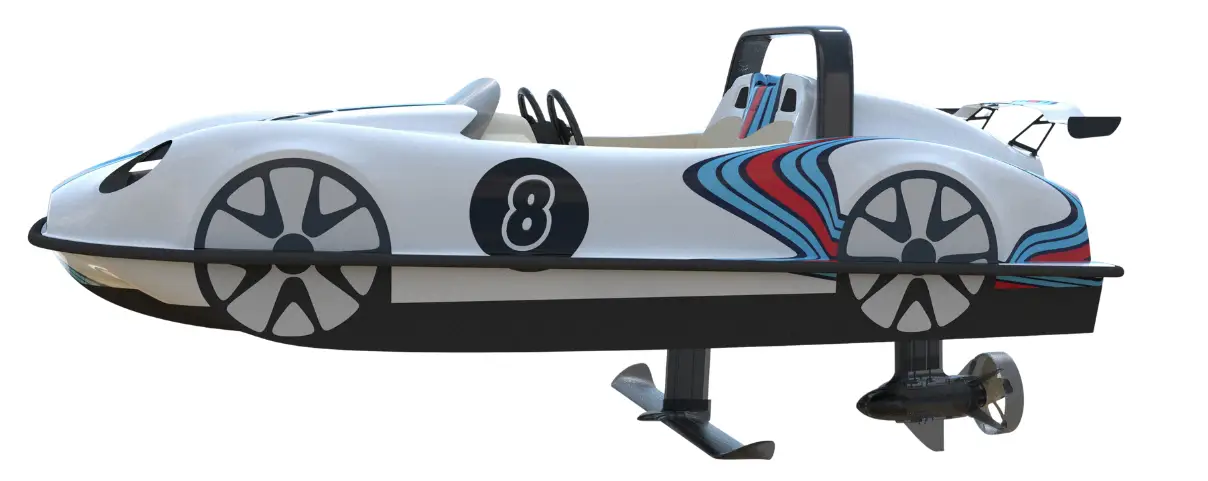
We explored full-flight hydrofoils for years. We made boats fly. Then we made a decision: stop chasing “visible flight” and focus on what truly matters in real-world use — stability, efficiency, simplicity, and a better glide at reasonable speed.
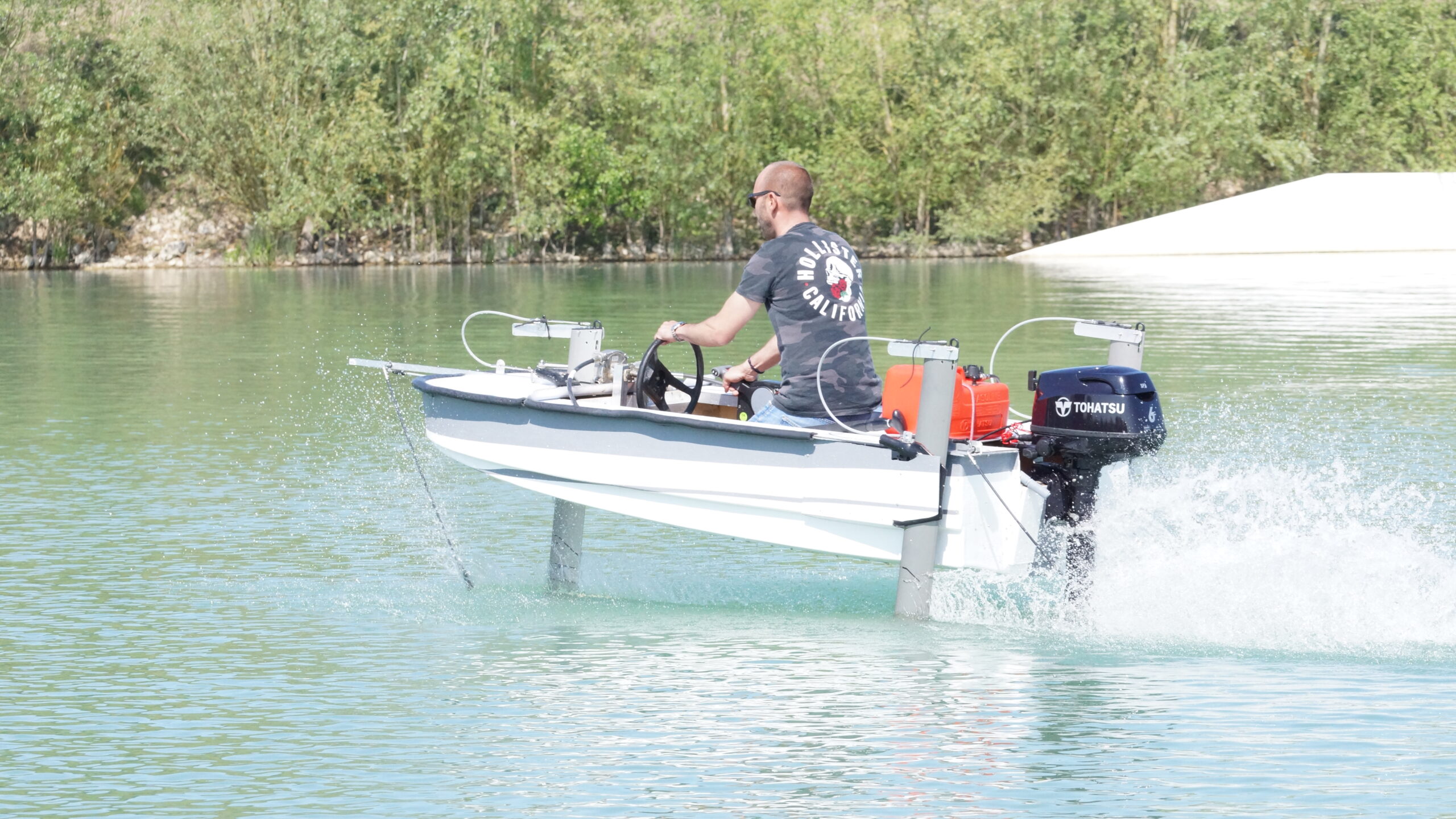
Flying can be spectacular. But for an accessible, robust and scalable leisure boat, we found a better answer: Skimming at water level.
A conventional boat stays fully immersed. Immersion creates hydrodynamic drag, energy loss, waves, and noise. So the real question is not “How do we leave the water?” but:
A Skimmer is neither a conventional planing boat nor a full-flight hydrofoil. It is based on partial lift: the foil carries a meaningful share of the boat’s weight, while the hull keeps a controlled contact with the water.
The boat runs at water level, not above it. You keep the benefits of lift while avoiding the instability and speed constraints of full flight.
Less wetted surface means less drag — typically 30–40% energy savings compared to a fully immersed hull, at comparable “usable” speed.
Skimming remains controllable at low speed. No “minimum flight speed” barrier. It stays predictable for novices, families, and professional operations.
The Skimmer approach is a pragmatic answer: you gain glide and efficiency without introducing fragile dependencies (active foil control, complex sensor loops, strict speed thresholds).
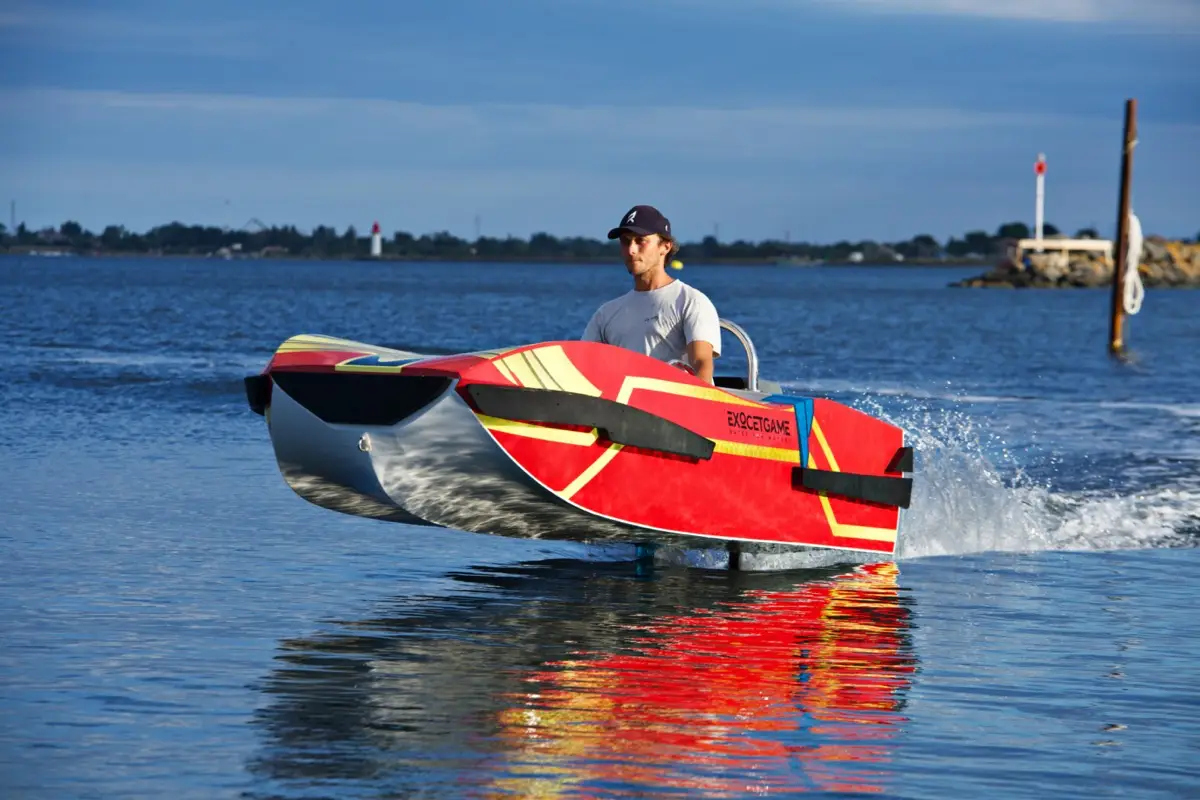
Our first Skimmers validated the power of a simple fixed foil. But intensive real-world use revealed a key truth: when you open the boat to all payloads, all profiles, and daily operations, stability becomes the priority.
Better lift distribution means a more stable trim and a more consistent behavior with changing passenger weight and conditions.
The goal is not to “fly more”. The goal is to stabilize skimming without adding complexity: no sensors, no active control.
For leisure operations, predictability is everything: smooth turns, controlled glide, and intuitive handling — even for first-time users.
Foil performance depends on trim. Our patented mass transfer system moves the battery pack longitudinally to place the boat in its optimal attitude.
Constant “right position” on the waterline to extract maximum efficiency from partial lift.
Stable behavior across different rider weights and operating conditions.
Less drag, smoother glide, better driving feel — without needing higher speed.
The Skimmer is not a shortcut. It is the result of years of prototypes, tests, and real-world operation.
Three-foil configurations, sensors and thermal propulsion. The boat flies — complexity shows up immediately.
Custom electric propulsion development. Efficiency and operational simplicity become central.
Two-foil flight improves stability, but remains speed-dependent and electronically demanding.
We move away from full flight. Fixed foil, dedicated hull, and a patented mass transfer system to optimize trim.
Sea and freshwater testing confirm stability, efficiency and low-maintenance operation.
Multiple seasons, thousands of users, intensive professional use. The concept proves itself outside the lab.
A logical refinement: more passive stability for skimming, same philosophy, same simplicity.
Because our goal is not to impress for 30 seconds. Our goal is to deliver a boat that is accessible, safe, energy-efficient, easy to operate, and robust — with a glide that feels exceptional at reasonable speed.